




Company Regulation in a Nutshell
A Company Regulation is a defined under Article 1 paragraph (1) of Regulation of the Minister of Manpower of the Republic of Indonesia Number 28 of 2014 on Procedures for the Formulation and Validation of Company Regulation as well as Formulation and Registration of Collective Work Agreement (“Permenaker 28/2014”) as a written regulation prepared by an employer containing the employment terms and internal company rules.
A Company Regulation shall be established by considering the suggestions and considerations from the workers’ representative, as regulated under Article 4 paragraph (1) of Permenaker 28/2014.
Further, according to Article 2 paragraph (1) of Permenaker 28/2014, Company Regulations are required for employers employing at least 10 (ten) workers. Within one company, only one Company Regulation shall apply, covering both PKWT and PKWTT employees.
What are the Contents of Company Regulations?
Under Article 2 paragraph (2) Permenaker 28/2014, Company Regulation shall at least contain:
- Rights and obligations of the Employer;
- Rights and obligations of the workers/laborers;
- Employment terms;
- Code of conduct of the company;
- Validity period of PP; and
- Matters which constitute further arrangements from laws and regulations.
In addition, in practice, it is highly recommended that Company Regulations also clearly regulate operational aspects such as working hours, leave mechanisms, disciplinary procedures, and grievance/sanctions handling processes to ensure clarity and avoid disputes.
It is important to note that if a Company Regulation differs from applicable Indonesian law, the provisions under the Company Regulation must not be less favorable to employees. The employer is required to provide terms that are at least equal to, or more favorable than statutory provisions as regulated under Article 2 paragraph (5) of Permenaker 28/2014.
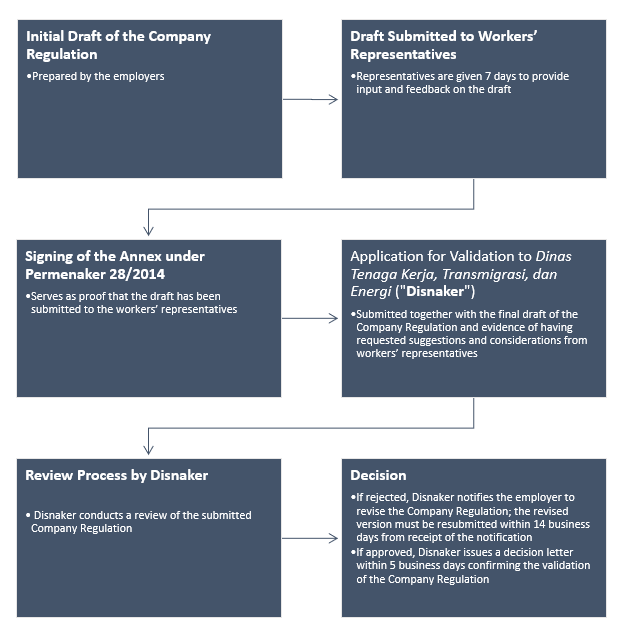
What Are the Procedures of Issuing Company Regulations?
(the information below will be designed in a flow chart for better readability)
What Shall Employers Do if an Amendment Is Required Within the Validity Period of a Company Regulation?
According to Article 12 of Permenaker 28/2014, the company is required to obtain revalidation from Disnaker. If the revalidation is not approved, the amendment is considered as non-existent (no changes occur to the Company Regulation). The amendment application must be completed with the required supporting documents as provided under Permenaker 28/2014.
What Are the Procedures for Company Regulation Renewal?
Renewal must be submitted no later than 30 business days prior to the expiration of the Company Regulation to Disnaker, supported by:
- the draft of the renewed Company Regulation; and
- evidence of having requested suggestions and considerations from workers representatives.
The renewal process is substantively similar to the initial submission process and requires revalidation from the relevant authority.
For Workers & Employers: Key Points You Should Pay Close Attention To
Based on our practice, there are several key aspects that employers should be particularly cautious about, including:
- Termination of Employment (PHK), which must be handled carefully to ensure compliance with applicable procedures and legal grounds;
- Annual Leave, which should be clearly regulated to avoid misunderstandings and disputes;
- Remuneration System, which must be structured transparently and aligned with statutory requirements;
- Overtime, which needs to be properly calculated and documented to ensure lawful compensation;
- Religious Holiday Allowance (THR), which must be provided in accordance with mandatory timing and calculation requirements under Indonesian law;
- Code of Conduct and Discipline, which should be clearly defined to maintain workplace order and consistency;
- Sanctions and disciplinary measures, which must be proportionate, clearly defined, and consistently applied.
Conlusion
Company Regulations play a crucial role in ensuring clear and structured employment relationships within a company. Employers are required to prepare, implement, and maintain these regulations in compliance with Permenaker 28/2014, while also considering suggestions and considerations from workers’ representatives. The content must at least meet the minimum standards set by Indonesian law and provide equal or more favorable terms for employees.
In practice, employers must also pay close attention to procedural requirements, including revalidation for any amendments during the validity period and timely renewal prior to expiration. Proper compliance with these requirements not only ensures legal certainty but also helps minimize potential disputes and supports a stable and productive working environment.
Disclaimer:
This article provides a concise overview of Company Regulations under Indonesian employment law, particularly under Minister of Manpower Regulation No. 28 of 2014, highlighting key requirements, procedures, and practical considerations for employers. Company Regulations are not merely administrative documents, but essential instruments governing employment relationships, internal policies, and workforce management. Non-compliance with statutory requirements may expose employers to legal risks and potential disputes. This material is prepared solely for informational purposes and does not constitute legal advice. Readers are advised to seek professional counsel for specific matters.